You may have noticed some new faces around the school and wondered who they are and why they are here.
Each year, we open our doors to interns from a wide range of backgrounds: BAFA, CAP AEPE, a Bachelor’s degree in Education Sciences, Erasmus (especially from Germany and Austria), and sometimes even Year 9/10 observation placements (3e). They don’t all have the same level of experience or the same objectives. Yet they all share one thing: a desire to understand the child, to improve, and to contribute to a lively educational environment.
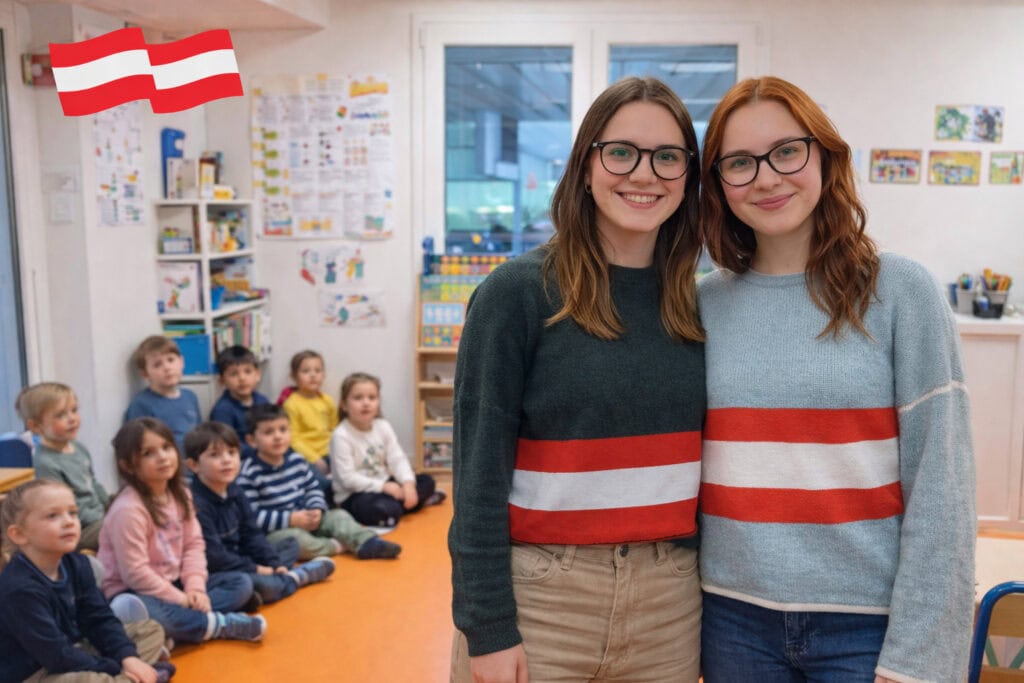
Lou from the Munich Art Lab; Paola from the public middle school in Sèvres; Sophie and Maya on an Erasmus stay from Austria; soon Enora from the ISRP psychomotricity school; and Elisabeth, currently training at Lycée Etienne Jules Marey.
Welcoming interns at the heart of classroom life is my way of helping future professionals give their very best to children—by observing our practices and applying them with kindness and care.
Why welcome interns in preschool?
An internship is not just about “watching.” It is an immersion in a demanding profession, alongside children who are developing rapidly. It is also a meeting point: between a school, a team, shared values… and a person who is building their professional identity and has something valuable to bring.
The profiles we welcome: different goals, one shared framework
BAFA: the energy of facilitation in service of the group
BAFA interns often arrive with a strong desire to act, engage a group, and propose games. In preschool, they learn to adapt their energy to children’s age and needs: rhythms, the need for calming moments, transitions, and emotional language. They discover that facilitation can be gentle—and that the quality of an activity is also measured by the inner calm it helps create.
CAP AEPE: everyday routines, safety, and care
The CAP AEPE focuses on core early-childhood skills: welcoming, hygiene, meals, nap time, and supporting independence. Interns develop a very valuable posture: observing carefully, supporting without doing things in the child’s place, and creating security through routine. They understand that care is not only technical—it is relational.
Education Sciences degree: understanding, analysing, building practices
These interns often arrive with analytical tools, theoretical references, and a desire to connect practice and reflection. Their placement becomes an observation field: classroom management, cooperation, language, inclusion, active pedagogies… They also help to put words on what is lived in class: writing, documenting, suggesting, questioning.
Erasmus (Germany / Austria): the richness of intercultural exchange
Welcoming Erasmus interns offers children a very concrete opening to the world. Another language, other habits, another way of playing, greeting, or telling a story… This fuels children’s curiosity and naturally strengthens the atmosphere of an open, bilingual school.
Year 9/10 observation placement (3e): discovering the professional world (and planting a seed)
A Year 9/10 placement is often a first step. We don’t expect technical skills, but a posture: observing, helping, respecting the framework, understanding responsibility. Sometimes it’s a revelation: “I want to work with children.” And even when it isn’t, it develops empathy and helps interns mature by experiencing the other side—the side of the “grown-ups” who support and pass on knowledge.
Our mission: welcome, support, help them grow
Welcoming interns takes time, organisation, and a real educational intention. It is a mission built around three pillars:
1) Offering a clear, reassuring framework
An intern doesn’t “improvise” their role as a trusted adult. Before their arrival, I meet each intern in an interview to understand their motivations and to present the school’s framework. The rules are clearly set: safety, confidentiality, posture, language, boundaries, conflict management, and their role in the classroom. A clear framework reassures everyone: the intern, the team, and the children.
2) Passing on a professional posture—not just tasks
With the educational team, my goal is not simply to “have them do things,” but to teach them how to see: observe a child, understand what is happening, anticipate, adjust one’s voice, distance, and pace. We pass on a relationship-based profession.
3) Turning the placement into a truly formative experience
A good placement is one where progress happens. This includes guided observation time; gradual responsibilities (never abrupt); regular, concrete, kind feedback; and recognising successes.
What’s in it for the children—concretely?
It might seem that welcoming interns mainly concerns adults. In reality, children benefit greatly—provided the placement is well supervised (which is our priority).
1) More attention, more availability
One more adult in the classroom often means more listening and more individual support: helping with a coat, putting words to an emotion, encouraging a shy child, supporting a difficult transition.
2) Richer and more varied activities
Interns bring ideas, games, songs, creative projects, and sometimes practices inspired by other countries or training programmes. This enriches daily classroom life without overloading it.
3) Learning to interact with different adults
Children learn that adults aren’t all the same and that we can adapt: listen to another voice, understand a different way of explaining, express a need to a new person. This is a precious social learning opportunity—especially in an environment where children feel safe and confident.
4) A natural cultural and linguistic opening
With Erasmus interns, language becomes alive: we hear different words, ask questions, compare. Children develop joyful curiosity without effort.
5) A model of an adult who is learning
Seeing an adult in training—observing, trying, improving, asking for advice—is powerful. It sends an implicit message: you’re allowed to learn, even when you’re grown up.
A win-win—on one condition: consistency and quality
Welcoming interns only makes sense if the school stays faithful to its priority: children’s wellbeing and development. That’s why we make sure to:
- choose tasks suited to the intern’s profile and the children’s age;
- guarantee safety (physical, emotional, relational);
- maintain pedagogical consistency;
- support the team, so that welcoming interns is a resource—not an invisible burden;
- and I do not hesitate to end a placement if I feel the intern does not have the right posture or cannot step back.
Conclusion: a school that passes on knowledge—and shines
Welcoming interns is a concrete way of saying: our school is a place of education, trust, and transmission. It’s also a way to prepare the future—training strong, humane, attentive professionals who know how to work as a team.
For children, it is a subtle but profound experience: they grow up surrounded by adults who care, cooperate, learn… and show that it is possible to build a living educational community, day after day.
Thanks to this approach, Jina and Neima—both former interns—have been part of the school team for the past two years, to everyone’s great happiness.
If you have any questions about welcoming interns, their role in the classroom, or the way we supervise their presence, please don’t hesitate to come and talk to me. Dialogue is part of our project.